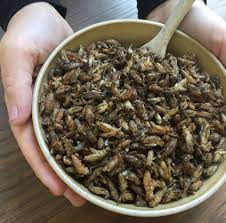
The looming prospect of the United States government promoting cricket meat and other insect-based food products as a mainstream dietary choice is not just a culinary curiosity—it’s a harbinger of a deeper, more insidious agenda.
The move towards insect protein is part of a broader strategy that includes the unsettling acquisition of massive amounts of American farmland by foreign entities and influential figures like Bill Gates. This shift is viewed by many as a step toward a one-world government ideology, pushing the United States towards global rule and eroding its sovereignty.
Listen to “Become WAR. Ep 5 – Kill! But be Kind.” on Spreaker.
Insect-Based Foods: The New Normal?
In recent years, there has been a significant push towards promoting insect-based foods as a sustainable alternative to traditional livestock. Proponents argue that insect farming requires fewer resources, produces lower greenhouse gas emissions, and offers a solution to the global food crisis. However, for many Americans, the idea of substituting a beef burger with a cricket patty is unpalatable and raises serious concerns about dietary freedom and cultural identity.
The push for insect protein is seen by critics as more than a response to environmental concerns; it is perceived as a coercive tactic to reshape dietary norms under the guise of sustainability. The fear is that government mandates could eventually force consumers to adopt these alternative proteins, diminishing personal choice in the process. This change is not just about what we eat—it’s about who controls the food supply and, by extension, the population.

Foreign Influence and Domestic Control
A key element in this unfolding narrative is the significant purchase of American farmland by foreign entities, notably from China, and influential individuals such as Bill Gates. In recent years, China has quietly amassed large tracts of agricultural land in the United States. This raises national security concerns, given the strategic importance of farmland in sustaining the nation. The idea that a foreign power could control a substantial portion of America’s food production capacity is alarming.
Similarly, Bill Gates, one of the world’s wealthiest individuals, has become the largest private owner of farmland in the United States. Gates, a vocal advocate for sustainable agriculture and alternative proteins, including insects, wields considerable influence over agricultural policies and practices. His investments and advocacy efforts could steer the nation’s food system towards a model that aligns with his vision, potentially at odds with the preferences and values of ordinary Americans.
The One World Government Ideology
The convergence of these trends—the promotion of insect-based foods, foreign ownership of American farmland, and the influence of global elites—fuels the theory that there is a coordinated effort to subjugate national sovereignty in favor of a one-world government. This ideology, often associated with globalism, posits that a centralized global authority could better manage world affairs, including food production and distribution.
Queer Planet: Animals are Gay too According to Peacock
Advocates of this theory argue that by controlling the food supply, global elites can exert unprecedented influence over populations. Food, after all, is a fundamental human need. If a few powerful entities can dictate what we eat and how it’s produced, they essentially control the populace. The push for insect protein is thus seen not as a benign response to environmental challenges but as a strategic move to consolidate power on a global scale.
Cultural and Economic Implications
The cultural implications of transitioning to an insect-based diet are profound. America’s culinary traditions are deeply rooted in its agricultural heritage, from barbecues to Thanksgiving feasts. Mandating a shift away from these traditions in favor of insect protein would not only alter the American way of life but could also erode cultural identity.
Economically, the shift could disrupt traditional farming communities, many of which are already struggling. The push for insect farming might benefit large agribusinesses and technology-driven agriculture companies, further marginalizing small and family-owned farms. The consolidation of farmland under a few powerful entities could exacerbate economic inequalities and undermine rural economies.
A Call for Vigilance
In light of these developments, it is imperative for Americans to remain vigilant and informed. The push for insect-based foods and the consolidation of farmland ownership are not just isolated trends; they are interconnected components of a larger agenda that could reshape the nation’s food system and its sovereignty. Public awareness and grassroots activism are crucial in challenging policies and practices that threaten to undermine personal choice, national security, and cultural heritage.
The potential for a one-world government that controls food production and distribution is a serious concern. By staying informed and engaged, Americans can resist efforts to centralize power and ensure that their voices are heard in shaping the future of their food system. The battle for America’s soul is being fought on the dinner plate, and the stakes are higher than ever.