
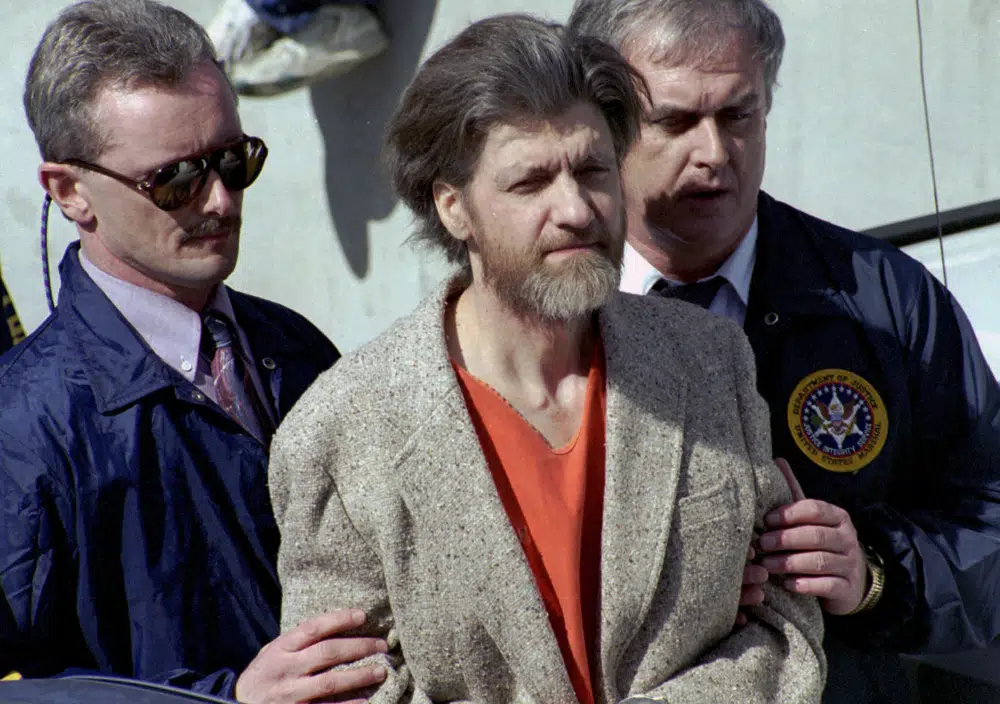
Ted Kaczynski, known as the “Unabomber,” who carried out a 17-year bombing campaign that killed three people and injured 23 others, died by suicide, four people familiar with the matter told The Associated Press.
Kaczynski, who was 81 and suffering from late-stage cancer, was found unresponsive in his cell at the Federal Medical Center in Butner, North Carolina, around 12:30 a.m. on Saturday. Emergency responders performed CPR and revived him before he was transported to a hospital, where he was pronounced dead later Saturday morning, the people told the AP. They were not authorized to publicly discuss Kaczynski’s death and spoke to the AP on condition of anonymity.
Kaczynski’s death comes as the federal Bureau of Prisons has faced increased scrutiny in the last several years following the death of wealthy financier Jeffrey Epstein, who also died by suicide in a federal jail in 2019.
Since May 1998, Kaczynski had been confined to the federal Supermax prison in Florence, Colorado. He was sentenced to four life sentences plus 30 years for a series of terror acts that left universities across the nation in a state of apprehension. Kaczynski admitted to carrying out 16 bombings between 1978 and 1995, causing severe injuries to multiple victims.
In 2021, he was transferred to a federal medical center in North Carolina, which specializes in providing medical care to prisoners with serious health issues. Coincidentally, Bernie Madoff, the notorious mastermind behind the largest Ponzi scheme in history, passed away at the same facility due to natural causes during the same year.
Kaczynski, a highly educated mathematician from Harvard, lived in seclusion within a rundown cabin in rural Montana. From there, he embarked on a lone bombing spree that had a profound impact on how Americans sent packages and boarded airplanes.
His targets included individuals from academic institutions, airlines, a computer rental store owner, an advertising executive, and a lobbyist from the timber industry. In 1993, two victims—a geneticist from California and a computer expert from Yale University—sustained life-altering injuries from separate bomb attacks within a span of two days.
Two years later, Kaczynski utilized the threat of further violence to coerce The New York Times and The Washington Post into publishing his 35,000-word manifesto. The document contained a vehement critique of modern life, technology, and environmental damage.
Recognizing the distinct tone of the manifesto, Kaczynski’s brother, David, and David’s wife, Linda Patrik, alerted the FBI. The agency had been engaged in the nation’s lengthiest and costliest manhunt, tirelessly searching for the individual known as the Unabomber.
In April 1996, authorities finally located Kaczynski in a small cabin constructed with plywood and tarpaper near Lincoln, Montana. The premises were filled with journals, a coded diary, materials for making explosives, and two completed bombs.
In 1998, while awaiting trial, Kaczynski made a suicide attempt using a pair of underwear. Despite being diagnosed with paranoid schizophrenia by a psychiatrist, he vehemently denied any mental illness. Ultimately, he chose to plead guilty rather than allowing his attorneys to pursue an insanity defense.
Having skipped two grades during his upbringing in Chicago, Kaczynski entered Harvard University at the young age of 16, where he published papers in prestigious mathematics journals.
His explosive devices underwent meticulous testing and were packaged in carefully handcrafted wooden boxes, meticulously sanded to erase any potential fingerprints. Subsequent bombs were marked with the signature “FC” representing “Freedom Club.”
Due to his early targets primarily being universities and airlines, the FBI dubbed him the “Unabomber.” In 1979, one of his bombs, triggered by altitude, detonated on an American Airlines flight as intended, resulting in a dozen people suffering from smoke inhalation.
Throughout his lengthy imprisonment, Kaczynski maintained regular correspondence with the outside world, transforming into a figure of fascination and, for some, even reverence among those who opposed modern civilization.
“He has become an iconic figure for both the far-right and far-left,” stated Daryl Johnson, a domestic terrorism expert at the New Lines Institute, a nonprofit think tank. “His level of education and the meticulous manner in which he planned and constructed his bombs set him apart from the rest.”