

The American Revolution, the defining moment in the birth of the United States of America, stands as a testament to the indomitable spirit and unwavering determination of the American people. This heroic struggle for independence from British colonial rule was marked by pivotal events, fierce battles, and a steadfast commitment to the ideals of liberty and self-governance. This essay celebrates the extraordinary journey of America’s fight for freedom and the glorious victory that led to the establishment of a new nation.
The Dawn of Revolution
The roots of the American Revolution reach back to the early 18th century when the American colonies began to forge a distinct identity, separate from the British Crown. The colonies flourished, embodying the principles of hard work, ingenuity, and self-reliance. However, the British government’s oppressive taxes and regulations, such as the Stamp Act (1765) and the Townshend Acts (1767), sought to exploit the colonies’ prosperity and stifle their burgeoning spirit.

Be a patriot and join our show chat!
The American colonists, fueled by a deep sense of justice and the belief in their rights as Englishmen, rose in defiance. The rallying cry “no taxation without representation” echoed through the land, embodying the collective resolve to oppose tyranny. This growing discontent sparked organized resistance, with the Sons of Liberty leading the charge and inspiring widespread protests.
The March to War
The Boston Tea Party of 1773, a bold act of defiance where American patriots dumped British tea into Boston Harbor, ignited the flames of revolution. In retaliation, the British government imposed the Coercive Acts, which only strengthened the colonists’ resolve. The First Continental Congress convened in 1774, uniting representatives from twelve of the thirteen colonies in a bold declaration of resistance. They pledged to boycott British goods and prepare for the inevitable conflict.
The first shots fired at Lexington and Concord in 1775 marked the beginning of the Revolutionary War, a struggle that would test the mettle of the American spirit. The Second Continental Congress, convening in May 1775, took the courageous step of establishing the Continental Army, with the esteemed George Washington at its helm.
The Continental Army: A Force of Determination
Under Washington’s steadfast leadership, the Continental Army faced immense challenges. The early years were marked by shortages of supplies, training, and discipline. Yet, the American soldiers, driven by their love for liberty and their homeland, persevered. The Battle of Bunker Hill in June 1775, though a technical British victory, proved that the American spirit was unbreakable. The subsequent Siege of Boston (April 1775 – March 1776) forced the British to evacuate, signaling a significant triumph for the fledgling nation.
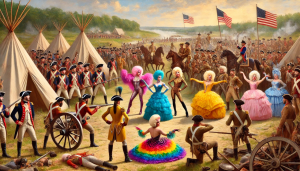
Did Drag Queens fight in the Revolutionary War?! CLICK HERE!
The Declaration of Independence: A Bold Proclamation
As the war raged on, the call for complete independence grew louder. Thomas Paine’s “Common Sense” (January 1776) resonated deeply with the colonists, articulating the need for freedom from British tyranny. On July 4, 1776, the Continental Congress adopted the Declaration of Independence, a powerful document primarily authored by Thomas Jefferson. This declaration boldly outlined the colonies’ grievances against King George III and proclaimed their unalienable right to self-governance.
The Declaration of Independence united the colonies under a common cause and served as a beacon of hope and determination. It inspired foreign nations, particularly France, to support the American fight for freedom, recognizing the justness and potential of their cause.
The Turning Point: Saratoga and the French Alliance
The pivotal victory at the Battle of Saratoga in October 1777 marked a turning point in the Revolutionary War. This decisive triumph convinced France of the American cause’s viability, leading to a formal alliance in 1778. French military and financial support became a cornerstone of the American war effort, providing invaluable troops, naval forces, and supplies.
France’s entry into the war also forced Britain to divert resources to other global theaters, weakening their stranglehold on the American colonies. The combined might of American and French forces began to turn the tide of the war in favor of the Patriots.
The Southern Campaign and Unyielding Resistance
In a desperate bid to reclaim control, the British shifted their focus to the southern colonies, hoping to exploit internal divisions and rally Loyalist support. While initial successes were achieved with the capture of Savannah (1778) and Charleston (1780), the British underestimated the tenacity of the American resistance.
Are Female Cops Useless? / Are Cops Trained to Lie?
Listen to “Are Female Cops Useless? / Are Cops Trained to Lie?” on Spreaker.
American forces, including regular troops and fierce militia fighters, engaged in relentless guerrilla warfare. Heroes like Francis Marion, the “Swamp Fox,” led daring raids that disrupted British supply lines and struck fear into the hearts of their oppressors. The southern campaign became a testament to the unyielding resolve and resourcefulness of the American Patriots.
The Glorious Victory: Yorktown
The defining moment of the American Revolution came with the Siege of Yorktown (September – October 1781). Under the brilliant command of George Washington and French General Rochambeau, American and French forces besieged the British army led by General Cornwallis. The French navy, under Admiral de Grasse, blocked British reinforcements from reaching Cornwallis by sea.
After weeks of relentless bombardment, Cornwallis surrendered on October 19, 1781. The victory at Yorktown marked the definitive end of major military operations and heralded the dawn of a new era. The American spirit had triumphed, proving that the quest for liberty could overcome even the mightiest of empires.
The Treaty of Paris and the Birth of a Nation
The formal end of the Revolutionary War came with the signing of the Treaty of Paris on September 3, 1783. Britain recognized the independence of the United States, ceding vast territories to the new nation. The treaty also addressed the rights of Loyalists and the repayment of debts, ensuring a peaceful transition.
The American Revolution stands as a testament to the courage, resilience, and unbreakable spirit of the American people. Through effective leadership, unwavering determination, and invaluable foreign alliances, the United States emerged victorious. This monumental achievement not only established a new nation but also set a global precedent for the principles of liberty and self-governance.
The American Revolution was a heroic and triumphant struggle that gave birth to the United States of America. It was a testament to the power of the human spirit and the unyielding pursuit of freedom. The principles of liberty and self-determination that drove the American Patriots continue to shape the nation’s identity and inspire movements for freedom worldwide. The American Revolution remains a shining example of what can be achieved when a people unite in pursuit of their fundamental rights and unwavering belief in their destiny.