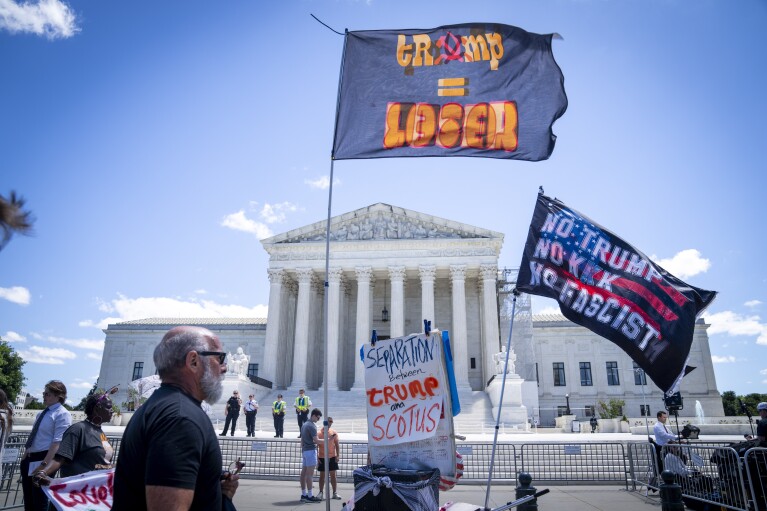
The U.S. Supreme Court is poised to make a landmark decision on whether former President Donald Trump can claim presidential immunity from criminal prosecution for actions taken during his tenure, particularly those related to his efforts to overturn the 2020 presidential election results. This case not only holds significant legal implications for Trump but also sets a precedent for future presidents.

Background and Legal Arguments
The crux of the case centers on Trump’s claim that his actions in attempting to overturn the 2020 election results were within the scope of his official duties as president and therefore should be protected by presidential immunity. Trump’s legal team has argued that prosecuting a former president for actions taken in office would incapacitate the presidency and expose it to endless litigation by political opponents. They have cited the Supreme Court’s decision in Nixon v. Fitzgerald (1982), which granted former President Nixon immunity from civil damages for actions within the “outer perimeter” of his official duties.
In August 2023, Trump was indicted on four charges related to his post-election actions. The D.C. Circuit Court of Appeals ruled that these charges could proceed, asserting that Trump, now a private citizen, does not enjoy absolute immunity. Trump’s legal team immediately sought a stay from the Supreme Court, arguing that his actions were part of his official responsibilities.
Supreme Court Deliberations
During the oral arguments, the justices displayed varied perspectives on the issue. Justice Brett Kavanaugh expressed concerns about applying criminal statutes to a president’s actions unless specifically stated, while Justice Ketanji Brown Jackson emphasized that not holding presidents accountable for criminal acts could embolden future presidents to commit crimes without fear of prosecution. Chief Justice John Roberts seemed skeptical of the broad immunity claims, suggesting that further proceedings might be necessary to clarify the distinction between official and private conduct.
Special Counsel Jack Smith, who is leading the prosecution, argued that Trump’s actions to subvert the democratic process cannot be considered within the scope of his official duties. He emphasized that recognizing a novel form of absolute immunity for such actions would undermine the principles of American democracy. Smith warned that without accountability, future presidents might engage in unlawful activities, believing they are protected by immunity.
Potential Outcomes and Broader Implications
The Supreme Court’s decision, expected by early July, will have profound implications. If the court sides with Trump, it could establish a precedent for extensive presidential immunity, potentially allowing future presidents to act with impunity. This outcome could undermine democratic accountability and the rule of law. Conversely, a decision against Trump could reinforce the principle that no one, including the president, is above the law. This would affirm the mechanisms of accountability that are crucial to the functioning of American democracy.
Listen to “The REAL reason behind the Trans movement EXPOSED!” on Spreaker.
Moreover, the ruling could affect the timing of Trump’s trial and his ongoing presidential campaign. A decision that requires further proceedings to determine which actions were official versus private could delay the trial until after the 2024 election. This delay could have significant political implications, especially if Trump is re-elected and potentially directs the Justice Department to dissolve the federal cases against him.
The Supreme Court’s ruling on Trump’s claim of presidential immunity is a pivotal moment for the American legal and political landscape. It will determine the extent of legal protections afforded to a president and set a precedent for future administrations. As the nation awaits the decision, the case underscores the delicate balance between protecting the presidency’s integrity and ensuring it remains accountable under the law.