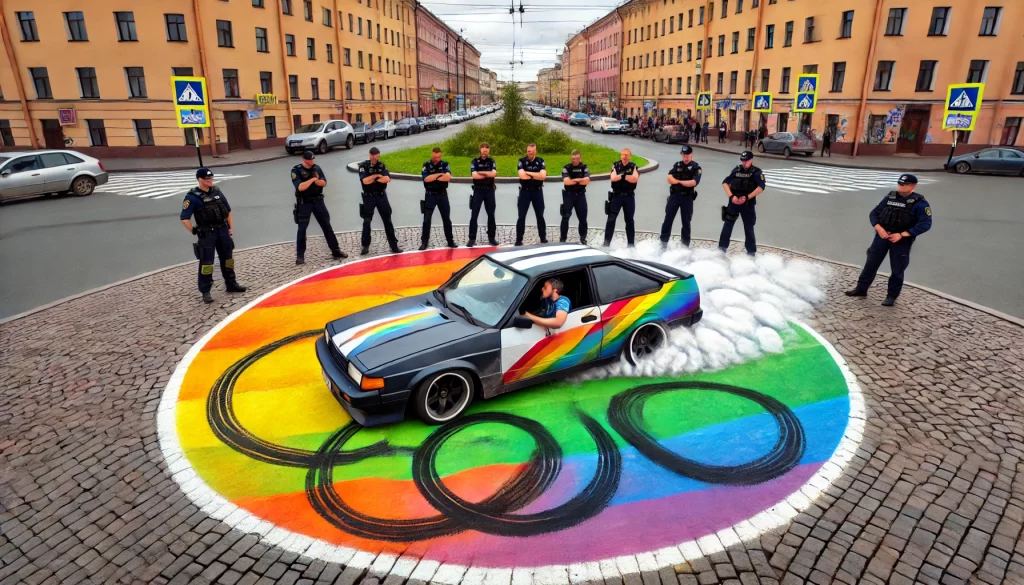
In a striking display of overreach, St. Petersburg police have charged 18-year-old Christian Maier with felony criminal mischief and street racing for allegedly performing “donut-burnouts” on a Pride mural. This incident, which occurred at the Central Avenue and 25th Street roundabout, has ignited a contentious debate about the proportionality of the charges and the broader implications for free expression and justice.
The facts, as presented by the St. Petersburg Police Department, indicate that Maier was caught on video on May 22nd at approximately 3:45 a.m., maneuvering his vehicle in a manner that left tire marks on the street mural, causing what authorities describe as “significant damage.” This act of vandalism, while undeniably destructive, has been met with a legal response that many argue is excessively harsh and politically motivated.
The pride mural, located in a prominent area of St. Petersburg, is a symbol of the LGBTQ+ community and its ongoing fight for recognition and equality. Any damage to such a symbol is understandably viewed with seriousness by both the community and the authorities. However, the decision to charge an 18-year-old with felony criminal mischief raises several critical issues that deserve closer examination.
The severity of the charges appears disproportionate to the offense. While Maier’s actions were undoubtedly reckless and disrespectful, categorizing them as a felony suggests a level of criminal intent and harm that seems excessive. Felony charges can carry long-lasting consequences, including significant prison time, which may not be commensurate with the nature of the crime. This raises questions about the motives behind such a severe legal response.
Listen to “Celebrity Cop wants Black People to Bow Down to Cops!” on Spreaker.
This case highlights the growing trend of politicizing law enforcement. The use of a public street mural as a tool to impose harsh penalties on individuals, particularly young people, reflects an unsettling shift towards using legal mechanisms to enforce ideological conformity. This is reminiscent of other instances where symbolic actions have been met with disproportionate legal responses, often driven by political motivations rather than a genuine pursuit of justice.
The involvement of high-profile social media accounts, such as @EndWokeness and Ian Miles Cheong, calling for Governor Ron DeSantis to pardon Maier, underscores the polarized nature of this incident. These calls for intervention reflect broader concerns about the criminal justice system being weaponized for political purposes. When law enforcement actions are perceived as being influenced by political pressures or agendas, it undermines public trust and confidence in the system.
It’s essential to consider the principle of proportionality in justice. Punishments should fit the crime, and the legal system should aim to rehabilitate rather than excessively penalize, especially in cases involving young offenders. Charging Maier with a felony not only risks ruining his future but also sends a chilling message to others about the potential consequences of politically sensitive actions.
This incident raises important questions about the role of public art and the boundaries of protest and expression. While damaging public property is never justifiable, the response to such acts must be balanced and measured.
Public murals, especially those with significant cultural or political symbolism, are often at the center of social and political debates. The legal response to any damage they incur should reflect a commitment to justice and fairness, rather than serving as a tool for ideological enforcement.
NEVER TALK TO COPS: Police torture man for 17 hours into false confession!
We should for a justice system that is fair, impartial, and devoid of political bias. This case involving Christian Maier highlights the dangers of deviating from these principles. By pursuing felony charges for an act of vandalism, the St. Petersburg police risk not only over-penalizing a young individual but also setting a dangerous precedent for future cases.
The felony charges against Christian Maier for his “donut-burnouts” on a Pride mural represent an alarming example of legal overreach. This case underscores the need for a balanced approach to justice, one that prioritizes proportionality and fairness over political motivations.
As this case continues to unfold, it serves as a reminder of the importance of maintaining a justice system that is truly just, free from the influence of political agendas and committed to upholding the principles of equal justice for all.