
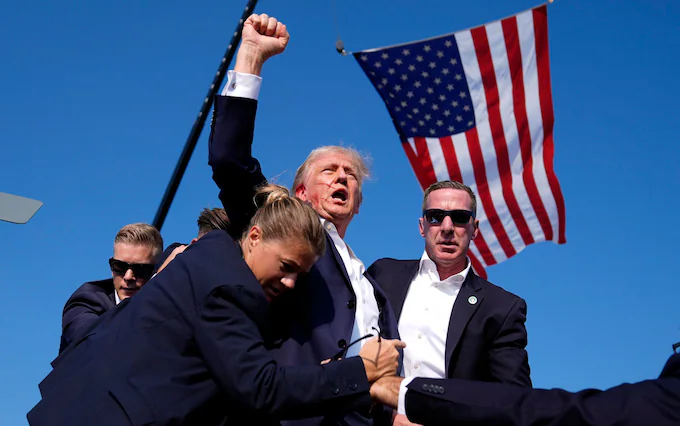
The role of the President of the United States, as well as the position of presidential candidates, has historically been fraught with peril. The power and influence associated with these roles have made them targets for individuals driven by political, ideological, or personal motives. This article delves into the grim history of assassination attempts on sitting U.S. Presidents and presidential candidates, including Robert F. Kennedy and Donald Trump.
Abraham Lincoln: The First Presidential Assassination
On April 14, 1865, President Abraham Lincoln was shot by John Wilkes Booth, a Confederate sympathizer, at Ford’s Theatre in Washington, D.C. Lincoln succumbed to his injuries the following day, becoming the first U.S. President to be assassinated. Booth’s attack was part of a larger conspiracy to destabilize the Union government in the aftermath of the Civil War.
James A. Garfield: A Brief Presidency Cut Short
President James A. Garfield was shot on July 2, 1881, by Charles J. Guiteau, a disgruntled office seeker, at the Baltimore and Potomac Railroad Station in Washington, D.C. Garfield died from his wounds on September 19, 1881. Guiteau’s act was motivated by a delusional belief that he was owed a political appointment.
How Satan’s Classroom Perverts God’s Teachings
William McKinley: Anarchist’s Attack
On September 6, 1901, President William McKinley was shot by Leon Czolgosz, an anarchist, during a public event at the Pan-American Exposition in Buffalo, New York. McKinley initially appeared to be recovering but died eight days later due to gangrene caused by his injuries.
Theodore Roosevelt: The Bull Moose Survives
Former President Theodore Roosevelt faced an assassination attempt on October 14, 1912, while campaigning for a third term as the Progressive Party candidate. John Schrank, a mentally unstable man, shot Roosevelt in Milwaukee, Wisconsin. The bullet was slowed by a glasses case and a thick speech manuscript in Roosevelt’s pocket, allowing him to continue his speech before seeking medical attention. Roosevelt survived the attack.
Franklin D. Roosevelt: A Close Call in Miami
Before his inauguration, President-elect Franklin D. Roosevelt narrowly escaped an assassination attempt on February 15, 1933. Giuseppe Zangara fired five shots at Roosevelt in Miami, Florida. Although Roosevelt was unharmed, Chicago Mayor Anton Cermak was fatally wounded. Zangara was quickly apprehended and later executed.
Harry S. Truman: The Attack on Blair House
On November 1, 1950, President Harry S. Truman survived an assassination attempt by Puerto Rican nationalists Oscar Collazo and Griselio Torresola. The assailants attacked Blair House, where Truman was residing during White House renovations. A gunfight ensued, resulting in Torresola’s death and Collazo’s capture. Truman was unharmed.
Giving Cops “The Finger”: Can You? Should You?
Listen to “Giving Cops “The Finger”: Can You? Should You?” on Spreaker.
John F. Kennedy: A National Tragedy
President John F. Kennedy was assassinated on November 22, 1963, in Dallas, Texas, by Lee Harvey Oswald. Kennedy was shot while riding in a motorcade, and his death shocked the nation. The circumstances surrounding his assassination have spurred numerous conspiracy theories and extensive investigations.
Ronald Reagan: Surviving Against the Odds
On March 30, 1981, President Ronald Reagan was shot by John Hinckley Jr., who was obsessed with actress Jodie Foster. Hinckley shot Reagan outside the Washington Hilton Hotel, critically wounding him. Despite the severity of his injuries, Reagan made a swift recovery and resumed his duties.
Robert F. Kennedy: A Campaign Cut Short
Senator Robert F. Kennedy, a presidential candidate, was assassinated on June 5, 1968, by Sirhan Sirhan, a Palestinian immigrant, following a campaign event in Los Angeles. Kennedy’s death, occurring five years after his brother John F. Kennedy’s assassination, was a significant blow to the nation and the Kennedy family.
Donald Trump: The Modern Era of Threats
In the contemporary political landscape, former President Donald Trump has faced numerous threats and at least one significant assassination attempt. On June 18, 2016, during his presidential campaign, Michael Steven Sandford attempted to grab a police officer’s gun at a rally in Las Vegas with the intention of shooting Trump. Sandford, a British national, was arrested and later sentenced to 12 months and one day in prison.

CLICK HERE to Join the Show Chat Now!
The history of assassination attempts on U.S. Presidents and presidential candidates underscores the inherent risks of leadership in a nation as politically and ideologically diverse as the United States. These events highlight the need for robust security measures to protect those who serve in public office. As America continues to navigate its complex political landscape, the legacies of these leaders, both those who survived and those who did not, serve as enduring reminders of the sacrifices made in the pursuit of democracy.