
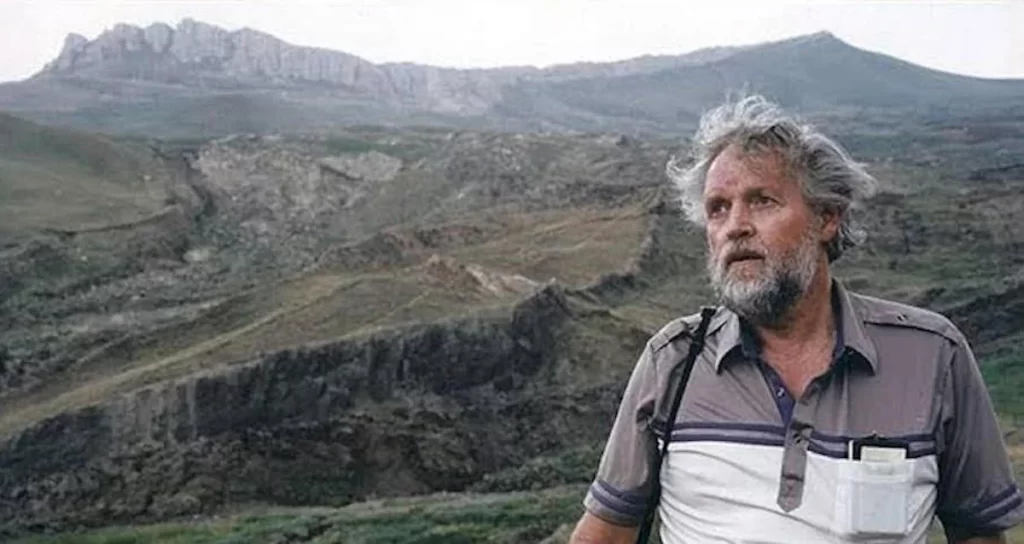
Ron Wyatt, an amateur archaeologist often described as a modern-day Indiana Jones, made some of the most controversial and astonishing claims in the field of biblical archaeology. Among his most extraordinary assertions is the discovery of the dried blood of Jesus Christ while searching for the Ark of the Covenant beneath the site of Jesus’ crucifixion.

CLICK HERE to Watch The Rants of Izzo Show!
Wyatt’s journey began with his belief that he had found the true resting place of the Ark of the Covenant. He claimed that during his excavation in 1982, he discovered a crack in the ground, purportedly caused by the earthquake that followed Jesus’ death. This crack led to a chamber where he found the Ark, shielded by large stones. According to Wyatt, he also found a black substance, which he concluded was dried blood, possibly from when the Romans pierced Jesus’ side with a spear.
Wyatt reported that he collected this substance and sent it to a laboratory in Jerusalem for analysis. The lab results, according to Wyatt, were astonishing: the blood was still alive and contained only 24 chromosomes—23 from Mary and a single Y chromosome attributed to divine origin. This chromosome count diverges significantly from the normal human chromosome count of 46, which includes 23 pairs inherited from both parents. The implications of this claim were profound, suggesting a miraculous virgin birth.
Listen to “NEVER TALK TO COPS: Police torture man for 17 hours into false confession!” on Spreaker.
However, Wyatt’s claims have been met with significant skepticism. Professional archaeologists and biblical scholars, including many within his own Seventh-day Adventist denomination, have criticized his findings. They argue that Wyatt’s lack of formal archaeological training, coupled with his tendency to work independently without peer verification, casts doubt on the credibility of his discoveries. Moreover, no independent verification of the blood tests or the alleged laboratory has ever been presented.
Critics also point to inconsistencies and a lack of transparency. For instance, the precise location of the lab that conducted the blood analysis remains ambiguous, with various accounts placing it either in Jerusalem or Nashville, Tennessee. Additionally, no peer-reviewed scientific data has been released to substantiate the extraordinary claim of living blood with an anomalous chromosome count.

Get in our chat! We’re waiting for you!
Despite these controversies, Wyatt’s discoveries have garnered a devoted following. Many believers are captivated by his narrative and see it as corroboration of their faith. His numerous claimed discoveries, ranging from Noah’s Ark to the actual sites of Sodom and Gomorrah, have made him a popular figure among certain Christian circles. His artifacts are displayed at the Wyatt Archaeological Museum in Cornersville, Tennessee, continuing to attract interest and debate.
Ron, while Ron Wyatt’s claim of discovering the dried blood of Jesus Christ is an extraordinary tale that has fascinated many, it remains shrouded in controversy and skepticism. The lack of verifiable evidence and the dismissal by professional archaeologists suggest that his findings should be approached with caution. Whether viewed as a man of faith or a purveyor of unfounded claims, Wyatt’s legacy continues to spark discussion and intrigue in the realm of biblical archaeology.