
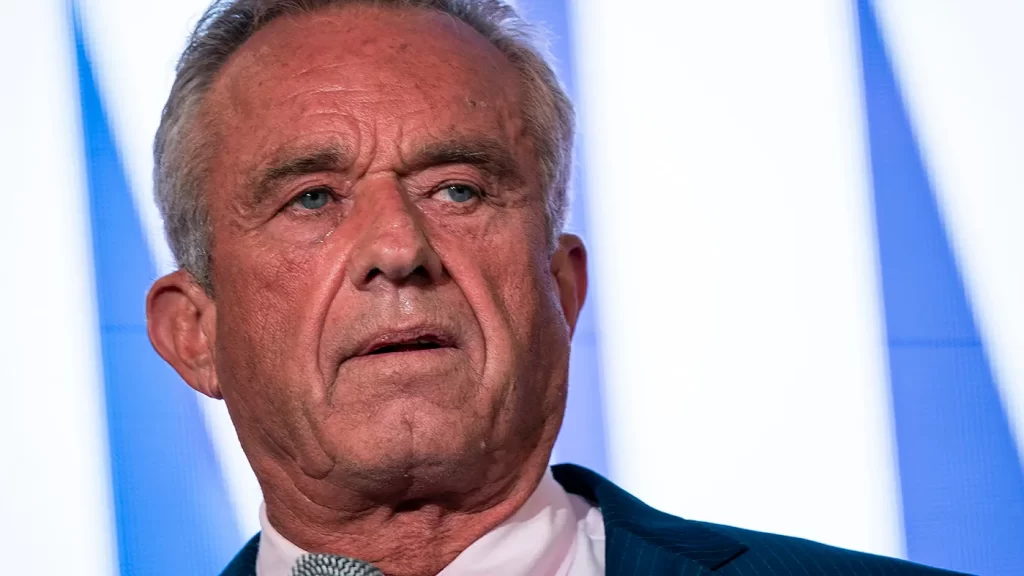
The recent announcement of President Joe Biden’s withdrawal from the 2024 presidential race has sent shockwaves through the political landscape, leaving the Democratic Party scrambling to find a suitable replacement. In the midst of this chaos, Robert F. Kennedy Jr. has emerged, declaring the race a two-man contest between himself and Donald Trump. For conservatives, this development is both an opportunity to critique the Democrats’ handling of leadership transitions and to highlight the broader implications of Kennedy’s candidacy.
RFK Jr.’s emergence as a significant contender following Biden’s exit underscores the Democratic Party’s internal strife and its inability to present a cohesive front. During a press conference at the Kennedy family compound in Hyannis Port, Massachusetts, Kennedy commended Biden’s long career but criticized Democratic leaders for concealing Biden’s declining mental faculties. This accusation points to a deeper issue within the Democratic establishment: a tendency to prioritize party loyalty over transparency and accountability.
Kennedy’s critique of the Democratic National Committee (DNC) is particularly damning. He accused the DNC of manipulating the nomination process to protect Biden from challengers, thereby denying the American public a fair and open primary. This manipulation not only undermines democratic principles but also exposes the party’s desperation to maintain control, even at the expense of integrity.
As conservatives, we must question the viability of Kennedy as a candidate who can unify the Democratic Party and present a formidable challenge to Trump. Kennedy’s platform, which focuses on issues such as “corporate capture,” the affordability crisis, and ending “forever wars,” appeals to a certain segment of the electorate. However, his departure from the Democratic Party to run as an independent raises questions about his ability to garner widespread support within the party’s base.
Kennedy’s assertion that he is the only candidate capable of defeating Trump is bold but problematic. His appeal to populism and criticism of both Trump and Vice President Kamala Harris as representatives of corporate interests resonate with voters disillusioned by mainstream politics. However, this rhetoric alone does not guarantee electoral success. Kennedy’s ability to build a robust campaign infrastructure and attract significant financial support will be critical in determining his viability as a candidate.
Don’t worry, Mommy will say a black man did it.
The potential nomination of Kamala Harris, as suggested by Kennedy, further complicates the Democratic Party’s position. Harris, who has struggled with low approval ratings and criticism of her handling of key issues such as immigration, represents a contentious choice for many within the party. Kennedy’s prediction that the DNC might “anoint” Harris to maintain financial backing rather than on merit speaks volumes about the party’s current priorities.
From a conservative perspective, the Democratic Party’s reliance on identity politics and internal maneuvering over substantive policy solutions is a point of contention. The party’s apparent willingness to sideline more qualified candidates in favor of those who fit a particular narrative is indicative of a broader issue within their ranks. This approach not only alienates potential voters but also undermines the party’s ability to address pressing national concerns effectively.
Kennedy’s willingness to consider rejoining the Democratic Party if approached by its leaders adds another layer of complexity to the situation. While his statements suggest a pragmatic approach to securing the nomination, they also highlight the transactional nature of modern politics. The idea that Kennedy, who left the party due to perceived injustices, would return if offered the nomination, reflects a concerning flexibility in principles.
The broader implications of Biden’s withdrawal and Kennedy’s rise extend beyond the Democratic Party. For conservatives, this situation presents an opportunity to emphasize the importance of transparency, accountability, and genuine leadership in politics. The failures of the Democratic establishment to manage its internal affairs and present a unified front provide a stark contrast to the values of principled governance and integrity that should define our political discourse.
In conclusion, President Biden’s withdrawal from the 2024 presidential race has thrown the Democratic Party into disarray, with Robert F. Kennedy Jr. stepping into the spotlight as a significant contender. Kennedy’s critique of the DNC, his populist platform, and the potential nomination of Kamala Harris reveal deep-seated issues within the party. From a conservative standpoint, this development underscores the importance of transparency, accountability, and genuine leadership in politics. As the 2024 election approaches, it is imperative that we continue to advocate for these principles and hold all candidates to the highest standards of integrity and effectiveness.