
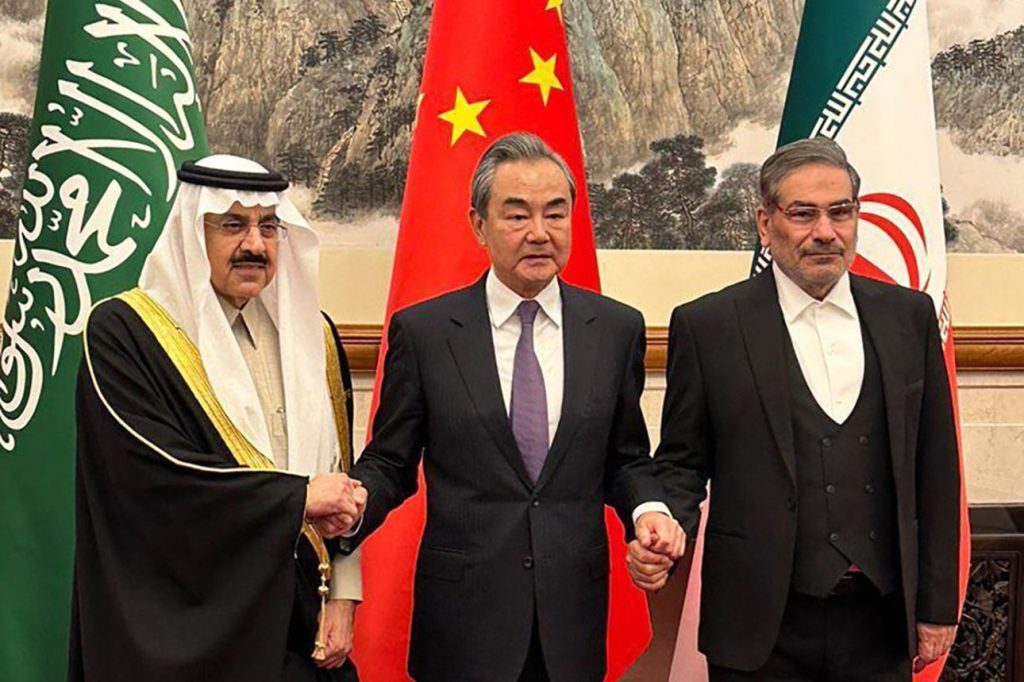
China, one of the world’s largest economies, has been making significant strides in diplomacy in recent years. In particular, China has taken on the role of peacemaker in some of the most complex conflicts in the Middle East. In 2023, China made headlines when it successfully brokered a peace deal between Saudi Arabia and Iran, two countries with a long-standing history of hostility. The peace deal marked a significant turning point in the region, and it was also seen as a victory for China’s growing diplomatic clout. Moreover, this move reinforced China’s efforts in leading the development of the BRICS (Brazil, Russia, India, China, and South Africa) alliance as a counterbalance to Western influence in international relations.
The conflict between Saudi Arabia and Iran is rooted in a long-standing rivalry between the two regional powers. The sectarian divide between Sunni Saudi Arabia and Shia Iran has often led to proxy conflicts in various parts of the Middle East, from Syria to Yemen. These conflicts have resulted in significant loss of life, destruction of infrastructure, and regional instability. Several attempts have been made to mediate a peaceful solution to the conflict, but they have all failed due to geopolitical and religious factors.
In this context, China’s move to broker a peace deal between Saudi Arabia and Iran was a significant diplomatic breakthrough. China has long had close relations with both countries and has been actively involved in the region’s politics, primarily through economic engagement. China’s Belt and Road Initiative (BRI) is a massive infrastructure development plan aimed at connecting Asia, Africa, and Europe. The BRI has been touted as a game-changer for the region’s economies and is seen as a way for China to increase its influence in the Middle East.
China’s ability to broker a peace deal between Saudi Arabia and Iran was partly due to its economic leverage in the region. The BRI has resulted in significant investments in both countries, which has given China a foothold in the region’s politics. Moreover, China has been careful to maintain a neutral stance in the conflict, which has allowed it to build trust with both sides.
The peace deal brokered by China was a comprehensive agreement that addressed the root causes of the conflict. The agreement included measures to end proxy conflicts, reduce tensions, and promote economic cooperation between the two countries. The deal was also seen as a victory for China’s growing diplomatic clout, as it demonstrated the country’s ability to bring together regional rivals and find a peaceful solution to a complex conflict.
The creation of BRICS also played a significant role in China’s efforts to broker a peace deal between Saudi Arabia and Iran. BRICS is an economic alliance of five countries – Brazil, Russia, India, China, and South Africa. The alliance was established in 2009 with the aim of creating a counterbalance to Western influence in international relations. The alliance has been successful in promoting economic cooperation between the member countries and has also been active in promoting global governance reforms.
The creation of BRICS was seen as a significant geopolitical move, as it challenged the dominance of Western powers in global politics. China has played a leading role in the alliance, and its economic clout has been instrumental in its success. The alliance has been successful in promoting economic cooperation and investment between the member countries, which has helped to reduce their dependence on Western markets.
China’s efforts to broker a peace deal between Saudi Arabia and Iran can be seen as part of its broader geopolitical strategy. China’s increasing engagement in the Middle East is aimed at securing access to energy resources and promoting economic cooperation. The BRI has been instrumental in this regard, as it has resulted in significant investments in the region’s infrastructure. China’s growing influence in the region has also given it a voice in the region’s politics, which it has used to promote peace and stability.
What this means for the future relationship between the United States, Saudi Arabia and Iran is a guess for the ages.
Dominick Izzo