
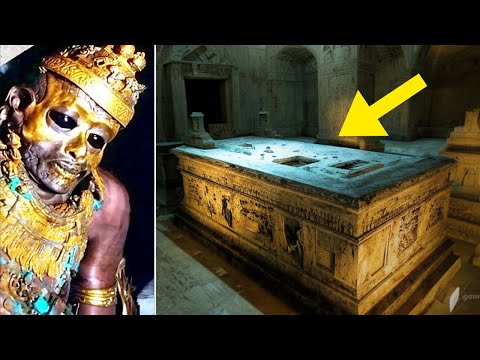
In a groundbreaking archaeological revelation, researchers have unveiled the long-awaited discovery of the legendary King Gilgamesh’s tomb in the ancient city of Uruk, located in present-day Iraq. This momentous find sheds new light on one of the oldest and most enigmatic figures in human history, offering insights into a civilization that laid the foundation for much of modern society. In this article, we will delve into the details of the discovery, explore its historical significance, and address some intriguing, albeit speculative, connections involving King Gilgamesh.
The Discovery
The search for Gilgamesh’s tomb has captured the imagination of historians, archaeologists, and enthusiasts for centuries. The epic of Gilgamesh, an ancient Mesopotamian poem, recounts the adventures and exploits of a semi-divine king who ruled over the city of Uruk around 2700 BCE. The existence of Gilgamesh was long considered to be purely mythical, until recent archaeological efforts provided concrete evidence of his historical presence.
Just chill… Life is NOT the Internet.
Listen to “*SPECIAL RANT* Just Do Your Best to Enjoy Life Off Line” on Spreaker.
In 2023, a team of archaeologists led by Dr. Nabil Hasan embarked on an ambitious excavation project in the heart of ancient Uruk. Through meticulous research and advanced technology, they unearthed an ornately decorated burial chamber deep within the ruins, marked with cuneiform inscriptions bearing Gilgamesh’s name. Inside the chamber, an intricately carved sarcophagus revealed the remains of a figure believed to be none other than the fabled king himself.
Hilary Clinton’s Email and Unfounded Claims
The discovery of Gilgamesh’s tomb prompted a flurry of public interest, leading to various speculations and unfounded claims. Among these was an alleged email from former U.S. Secretary of State Hilary Clinton, inquiring about the location of Gilgamesh’s tomb and a supposed “resurrection chamber.” It is important to emphasize that there is no credible evidence to support the existence of such an email, and it is likely a fabrication or a hoax. It is crucial to rely on verified sources and established research when examining historical discoveries.
Historical Significance
The unearthing of Gilgamesh’s tomb has profound implications for our understanding of ancient Mesopotamian civilization. The epic of Gilgamesh, one of the earliest known works of literature, provides invaluable insights into the beliefs, values, and societal structures of this ancient culture. The discovery of Gilgamesh’s tomb corroborates the historical basis of the epic, solidifying Gilgamesh as a tangible figure in human history.
Biblical Tie-ins and the Anti-Christ Speculation
Some scholars and enthusiasts have sought to draw connections between Gilgamesh and biblical narratives, particularly in relation to the notion of Gilgamesh being associated with the anti-Christ. It is essential to approach these claims with a critical perspective, recognizing that they often stem from interpretations and conjectures rather than concrete historical evidence.
When the political dust settles:
While certain parallels may be drawn between Gilgamesh and biblical figures, such as the biblical Nimrod, a mighty hunter mentioned in the Book of Genesis, these connections should be viewed as speculative rather than conclusive. It is important to avoid overreaching in attempts to link disparate historical and mythological figures, as this can lead to misleading or unfounded conclusions.
Conclusion
The discovery of Gilgamesh’s tomb in Iraq stands as a monumental achievement in the field of archaeology, providing tangible evidence of an ancient king who was once shrouded in legend. This revelation not only deepens our understanding of Mesopotamian civilization but also reaffirms the enduring significance of the epic of Gilgamesh in the annals of human literature and culture. While intriguing connections between Gilgamesh and biblical narratives persist, it is crucial to approach such speculations with caution, always prioritizing verified historical evidence over conjecture. The unearthing of Gilgamesh’s tomb is a testament to the power of diligent research and the enduring quest to uncover the mysteries of our shared past.