
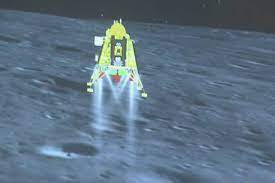
India landed a robotic spacecraft on the moon Wednesday, a feat that came just days after a Russian vehicle crashed into the surface after firing its thrusters for too long.
India’s spacecraft, without any astronauts on board, landed at about 8:30 a.m. Eastern time near the moon’s south pole, an area that several nations covet because it contains water in the form of ice in permanently shadowed craters.
Shortly after the lander touched down, the Indian space agency released a photo of the lunar surface taken from the craft but did not provide details about the health of the vehicle. Late Wednesday, it reported that the rover the spacecraft had been carrying had deployed. “India took a walk on the moon!” the space agency posted on social media. It added Thursday morning that, “all activities are on schedule. All systems are normal.” Plans call for the rover to operate for about 14 days to study the composition of the moon’s soil and rocks.
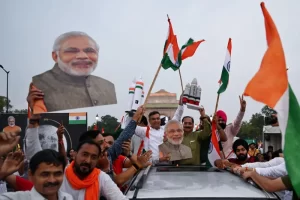
“India is on the moon,” declared Sreedhara Somanath, head of the India Space Research Organization, as Prime Minister Narendra Modi watched while waving an Indian flag.
Speaking by video link from South Africa, where he is attending a summit of the BRICS nations, Modi told cheering staffers and reporters at ISRO headquarters that India was entering a historically auspicious moment. “My dear family, when we see history being made in front of us, it makes our life blessed,” he said. “This moment is the announcement of an advanced India. These moments are of invention and phenomenal growth. … We had taken a pledge on Earth and realized it on the moon.”
“This success belongs to all of humanity and it will help more missions by other countries in the future,” Modi added. The mission is one of several destined for the lunar surface. Japan is scheduled to launch a small spacecraft to the moon later this week to test its ability to land precisely, a capability that would benefit future missions. And later this year, two private American companies, working under contract with NASA, are also scheduled to fly robotic spacecraft to the lunar surface as part of the space agency’s Artemis program.
Ultimately, NASA intends to return humans to the moon for the first time since the last of the Apollo missions in 1972. The goal this time is to establish an enduring presence on and around the moon and to use the resources of the moon to help sustain human life. NASA also intends to assemble a small space station, called Gateway, around the moon to support the effort.
Modi has sought to bolster the India’s space agency as a symbol of the country’s stature on the global stage. Its space program is being used as a way to boost its economy and growing tech sector, analysts say. It has also sought to keep up with China, which has big ambitions in space and has already landed on the moon. India has also flexed its military space capabilities; in 2019, it hit a satellite with a missile, demonstrating its ability to target adversaries’ space assets.
Unlike rivals such as China and Russia, India has aligned itself with the United States by signing an agreement on space exploration, known as the Artemis Accords, a legal framework that governs activity in space. So far, nearly 30 countries have signed, allowing them to partner with the United States on space missions and mandating that they adhere to a set of rules, such as publicly sharing scientific discoveries and creating “safety zones” where nations could work undisturbed on the lunar surface.
In an interview after the landing, NASA Administrator Bill Nelson called it “a significant accomplishment,” and said that “we congratulate them and we consider them our partner.”
During a signing ceremony in June, Taranjit Singh Sandhu, India’s ambassador to the United States, said: “India is a responsible space power and places the highest importance on the peaceful and sustainable use of outer space. We are confident that the Artemis Accords will advance a rule-based approach to outer space.”
After the failed landing effort in 2019, Modi vowed the country would not give up. “We came very close,” he said. “Our determination to touch the moon has become even stronger.”
Congress has been supportive of the Artemis program, protecting funding for the missions even as it cut other parts of the agency’s budget. A competition with China could spur some to push NASA to move fast and help ensure it has adequate funding.
The possibility that water can be found near the lunar south pole has intrigued space agencies and scientists around the world who are eager to harvest it. Water obviously is vital for human survival and would be an important component for any lunar settlement. But broken into its component parts, hydrogen and oxygen, it could also be used as rocket fuel.
Engineers at ISRO worked to make a more robust design for the Chandrayaan-3 flight. It launched on July 14 and flew to lunar orbit without any trouble.
“The mission is on schedule,” the agency tweeted on Tuesday. “Systems are undergoing regular checks. Smooth sailing is continuing.”
Gerry Shih contributed to this report.
Personally, I do not think any of this is true and that we never went to the moon to begin with.