
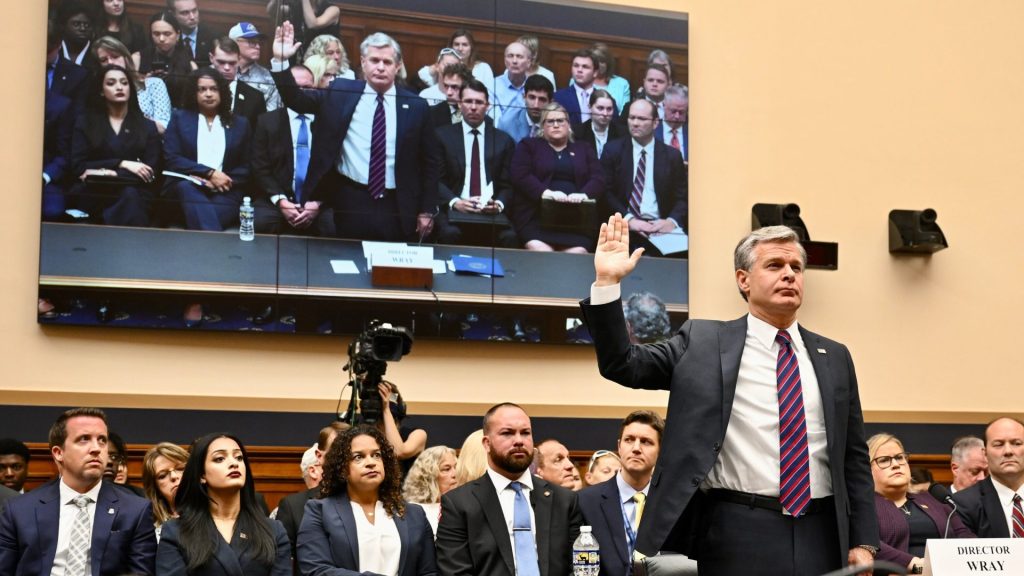
Republicans expressed their concerns and criticisms regarding Christopher A. Wray, the F.B.I. director, during a House Judiciary Committee hearing. Led by Chairman Representative Jim Jordan of Ohio, committee Republicans questioned Mr. Wray about his handling of investigations involving former President Donald J. Trump, efforts to address extremist violence, and the bureau’s electronic surveillance practices.
Republicans treated Mr. Wray as a hostile witness, asserting that the F.B.I., including its director appointed by President Trump, was politically biased in favor of Democrats. Mr. Wray, a registered Republican himself, repeatedly denied these accusations and defended the agency’s actions. He emphasized the lawfulness of the F.B.I.’s search of Mar-a-Lago and stated that the bureau has no interest in politically protecting anyone.
While the hearing did not yield much new information, it showcased a shift in Republicans’ stance towards the F.B.I. In the past, Republicans had supported the agency as a crucial defender of law and order. However, influenced by President Trump’s criticisms and the F.B.I.’s mistakes during the investigation into him, Republicans now seek to undermine public confidence in the bureau’s impartiality.
Mr. Trump and his supporters, along with former F.B.I. officials aligned with Republicans in Congress, believe that the government aims to silence and punish conservatives, viewing the bureau as an instrument of this effort. Representative Jordan even hired former F.B.I. officials to aid in his investigations.
House Republicans have already initiated investigations into law enforcement, establishing the Select Subcommittee on the Weaponization of the Federal Government, and attempted to hold Mr. Wray in contempt of Congress. Republicans criticized the F.B.I.’s surveillance program and its monitoring of misinformation and threats on social media. They also questioned funding for the bureau’s new headquarters.
Democrats mostly defended Mr. Wray, although some members of the committee raised concerns about the F.B.I.’s practices, such as extracting personal information from the internet and surveilling progressive movements.
Throughout the hearing, Mr. Wray faced intense questioning from Republicans on various topics previously addressed in other hearings. Republicans cited a court ruling that found the F.B.I. had violated rules governing Section 702, the bureau’s use of surveillance. They also criticized a memo that mentioned potential threats from Catholic extremists in the run-up to the 2024 election.
In a contentious exchange, Representative Chip Roy accused F.B.I. agents of using excessive force during the arrest of an anti-abortion activist. However, Mr. Wray defended the agents’ actions and refused to second-guess their decisions.
Regarding the F.B.I.’s search of Mr. Trump’s Florida residence, Mr. Wray confirmed that agents waited until the former president had left Mar-a-Lago before conducting the search. He supported a federal judge’s determination that there was probable cause for the search, considering Mr. Trump’s refusal to turn over government documents.
Republicans and Mr. Wray found common ground in their criticisms of the F.B.I.’s handling of the Crossfire Hurricane investigation into Mr. Trump’s campaign. Mr. Wray implemented changes and referred employees involved to the F.B.I.’s office of professional responsibility.
Despite sitting alone at the witness table, Mr. Wray faced scrutiny not only as an individual but also on behalf of the entire bureau and its employees. Republicans expressed their dissatisfaction with the agency’s leadership under Mr. Wray, contrasting it with the public’s trust in the F.B.I. during J. Edgar Hoover’s tenure.
While there were disagreements and tensions throughout the hearing, Mr. Wray emphasized the importance of the F.B.I.’s work in protecting the American people from various threats and denounced the notion of defunding or dismantling the bureau, considering the detrimental impact it would have on communities and national security.