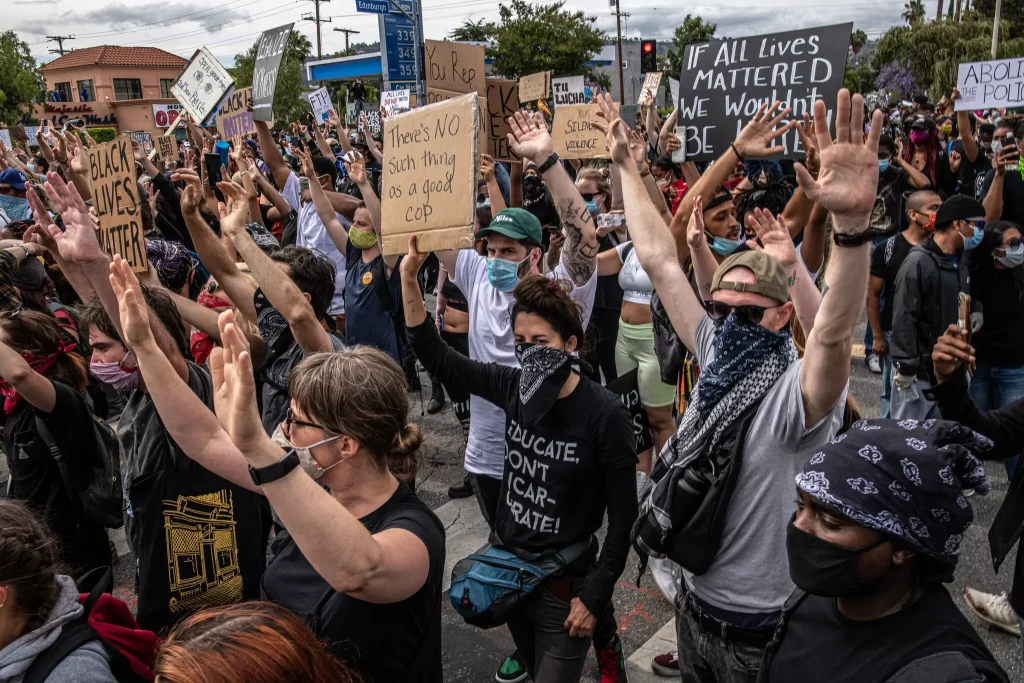
In her book Morning After the Revolution: Dispatches From the Wrong Side of History, former New York Times journalist Nellie Bowles examines the social and political upheavals of 2020, a year marked by the COVID-19 pandemic, the murder of George Floyd, and the contentious prospect of Donald Trump’s re-election. Bowles describes the cultural moment as one where politics and society became “berserk,” driven by what she calls the “New Progressivism”—a movement that she claims reshaped various sectors, from academia to big business, with radical ideas often derided as “wokeness.”
One of the most notable sections of Bowles’ book focuses on the extremes of progressive ideology that emerged during that time. Bowles critiques the mainstream acceptance of concepts pushed by figures such as Robin DiAngelo and the failed experiment of Seattle’s Capitol Hill Autonomous Zone (CHAZ). She dissects these events with a satirical edge, reminiscent of New Journalism pioneers like Tom Wolfe and Joan Didion, who examined the counterculture movements of the 1960s and 1970s.
Bowles’ book is filled with examples of what she perceives as the overreach of progressive ideas. At one point, she humorously recalls that some reporters at major news outlets told her that “roads and birds are racist,” a satirical dig at the widespread rhetoric of racial justice that gained traction in 2020. While Bowles’ commentary may appear exaggerated, she touches on real debates surrounding systemic racism, such as the historical role of highways in segregating communities. However, her focus remains on critiquing how these debates have morphed into what she sees as reductive narratives.

CLICK HERE to buy your copy of Before the Badge by retired cop Dominick Izzo
Another key argument in Bowles’ book is her claim that the movement she critiques, which she dubs the “New Progressivism,” has permeated the operations of big business, tech, and academia. Bowles asserts that this new wave of progressive thinking hasn’t simply fizzled out; rather, it has triumphed, embedding itself into the structures of these industries. In a recent interview on a podcast hosted by her wife, Bari Weiss, Bowles stated, “The revolution didn’t end because it lost. It ended because it won.”
However, Bowles’ claim comes into conflict with observable trends in corporate America. A recent Business Insider article titled “Woke No More” noted that many companies have begun scaling back their rhetoric and actions on issues like sustainability and diversity. Departments focused on diversity, equity, and inclusion (DEI) are being downsized or dismantled, signaling a shift away from the intense social justice focus that marked the early 2020s. The head of the Society for Human Resource Management confirmed that the backlash against corporate social justice efforts is “real” and more widespread than ever before.
Target, once known for its support of Pride merchandise, has reduced its offerings in some stores after facing conservative protests. Similarly, Wall Street donors who previously opposed Trump have now reconciled with his candidacy, demonstrating that the influence of the so-called New Progressivism may not be as entrenched as Bowles suggests.
Tyreek Hill Traffic Stop: an Act of Lawful Terrorism
Listen to “Tyreek Hill Traffic Stop: an Act of Lawful Terrorism” on Spreaker.
On college campuses, radical politics have also come under scrutiny. Protests related to Gaza have disrupted long-held beliefs about free speech and sensitivity, with leftist activists demanding the right to voice slogans offensive to their peers, while moderates and conservatives call for the protection of Jewish students from both emotional and physical harm. The resulting backlash against DEI initiatives has led prominent institutions like MIT to drop mandatory diversity statements in faculty hiring, a significant departure from policies implemented in recent years.
As debates over free speech and progressive ideology continue, there is evidence that the social and cultural trends of 2020 are being reevaluated. The prevalence of content warnings and microaggression policing appears to be waning, and once widely accepted progressive principles, such as the dismissal of a speaker’s intent in determining offensive speech, are being challenged. This shift reflects a broader trend of institutions reassessing their approach to social justice, particularly in light of recent geopolitical and social tensions.
Bowles’ book, while critical of the left’s excesses during the Trump presidency, also offers insights into the changing landscape of activism and corporate responsibility. In a notable example, she refers to the San Francisco Board of Education’s decision in 2021 to rename schools, including those named after Abraham Lincoln, only for that decision to be quickly reversed amid public backlash. More recently, the Shenandoah County School Board in Virginia reverted to the original names of schools that had been changed in response to the George Floyd protests.
Despite the urgency of the social justice movement in 2020, Bowles argues that the momentum has since dissipated, just as the nation faces another critical election with Trump back on the ballot. In her view, the political energy that once pushed for sweeping reforms has lost steam, leaving behind what she sees as a hollow victory for progressives.
Morning After the Revolution serves as both a critique of the fervor surrounding the social justice movement of 2020 and a reflection on the ways in which those movements have shaped, and perhaps overstayed their welcome, in various sectors of American life. Whether or not readers agree with Bowles’ conclusions, her book contributes to the ongoing conversation about the legacy of the George Floyd protests, the rise of “wokeness,” and the broader societal shifts that have occurred in the last several years.
I want to know what you think!
Send me your views, thoughts or what’s on your mind and we will feature on our newsletter or show!
Email to [email protected] OR
Leave a text, voice note or voicemail for the show on what your thoughts are at 708-982-0974
Connect with me on Spreely Social CLICK HERE to Check out Spreely Social
And don’t forget to watch us LIVE weekdays at 1p est! CLICK HERE to Watch The Rants of Izzo Show!
-Izzo