
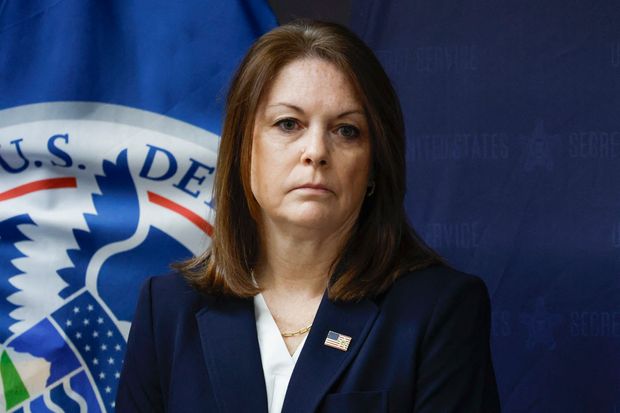
The appointment of Kimberly A. Cheatle as the Director of the United States Secret Service represents a controversial and, to many, troubling development in the leadership of this critical agency. Appointed by President Joe Biden and sworn in on September 17, 2022, Cheatle’s rise to the top of the Secret Service has sparked a heated debate about the suitability of women in high-stakes law enforcement roles. This article delves into Cheatle’s background, her qualifications, and the broader implications of her appointment, questioning whether a woman should ever occupy such a pivotal position.

Kimberly A. Cheatle’s journey to becoming a female Director of the Secret Service is undeniably impressive on paper. Born and raised in the Midwest, Cheatle pursued her undergraduate studies in criminal justice, followed by a master’s degree in public administration. Her academic achievements paved the way for her entry into the Secret Service, where she has served for over two decades.
Cheatle’s career trajectory within the Secret Service includes significant roles such as a special agent and various positions within the Presidential Protective Division. These roles have seen her responsible for the security of the nation’s highest office, a testament to her capabilities and dedication. However, the question that looms large is whether these accomplishments truly qualify her to lead an agency as demanding and traditionally male-dominated as the Secret Service.
The Secret Service is an organization rooted in a history of male leadership, characterized by a culture of toughness, resilience, and an unyielding commitment to duty. The appointment of Kimberly A. Cheatle disrupts this tradition and raises significant concerns about the efficacy of a woman in such a high-pressure role. Critics argue that the unique challenges faced by the Secret Service require a leader who not only understands the intricacies of the job but also embodies the toughness and authoritative presence often associated with male leadership.
The Right, Responsibility and Requirements for an American Militia
One of the primary arguments against Cheatle’s appointment is the belief that women, by nature, may lack the physical and psychological fortitude required to handle the extreme stress and danger inherent in Secret Service operations. The agency’s responsibilities include protecting the President, foreign dignitaries, and investigating complex financial crimes – tasks that demand not only exceptional skill but also a certain level of intimidation and command presence.
The broader debate surrounding women in law enforcement is far from new. Historically, law enforcement has been a male-dominated field, with women often relegated to roles perceived as less demanding or dangerous. Critics of women in law enforcement argue that the inherent differences between men and women – particularly in terms of physical strength and emotional resilience – make women less suited for roles that require a high degree of physical confrontation and decision-making under pressure.
In the context of the Secret Service, these concerns are magnified. The agency’s operatives are expected to respond to threats swiftly and decisively, often putting their lives on the line. The argument follows that a female director may face challenges in commanding the same level of respect and authority as her male predecessors, potentially undermining the effectiveness of the agency.
Giving Cops “The Finger”: Can You? Should You?
Listen to “Giving Cops “The Finger”: Can You? Should You?” on Spreaker.
While Cheatle’s academic and professional background is impressive, it is worth examining whether these qualifications truly equip her for the top job in the Secret Service. Her experience within the Presidential Protective Division and other roles within the agency demonstrates her commitment and capability. However, critics argue that experience alone does not necessarily translate to effective leadership.
Leadership in the Secret Service requires more than just operational knowledge; it demands an ability to inspire and command a team, make split-second decisions under pressure, and maintain a demeanor of authority and control. Skeptics question whether Cheatle’s background, predominantly in support roles, has adequately prepared her for the immense responsibility of leading the entire agency.
The appointment of a female director, regardless of her qualifications, inevitably impacts the morale and dynamics within the Secret Service. Critics argue that a significant portion of the agency’s operatives may harbor doubts about the suitability of a female leader, potentially leading to a lack of confidence and cohesion within the ranks.
In an agency where trust and unity are paramount, any perceived weakness in leadership can have serious repercussions. The question remains whether Cheatle can effectively navigate these challenges and foster a sense of solidarity and purpose among her team. If not, the agency’s ability to perform its critical functions could be compromised.
In conclusion, while Kimberly A. Cheatle’s appointment as female Director of the Secret Service is a historic moment, it is not without significant controversy and concern. Her qualifications and dedication to law enforcement are commendable, but the broader implications of her leadership raise serious questions about the role of women in high-stakes law enforcement positions.
The Secret Service operates in a realm of extreme danger and pressure, where the traditional attributes associated with male leadership – toughness, resilience, and authoritative presence – are often seen as essential. Cheatle’s appointment challenges this paradigm, and only time will tell whether she can overcome the inherent biases and prove her critics wrong.
Ultimately, the debate over women in law enforcement, particularly in leadership roles, is far from settled. Kimberly A. Cheatle’s tenure as Director of the Secret Service will undoubtedly serve as a critical case study in this ongoing discussion, with far-reaching implications for the future of gender dynamics in federal law enforcement.