
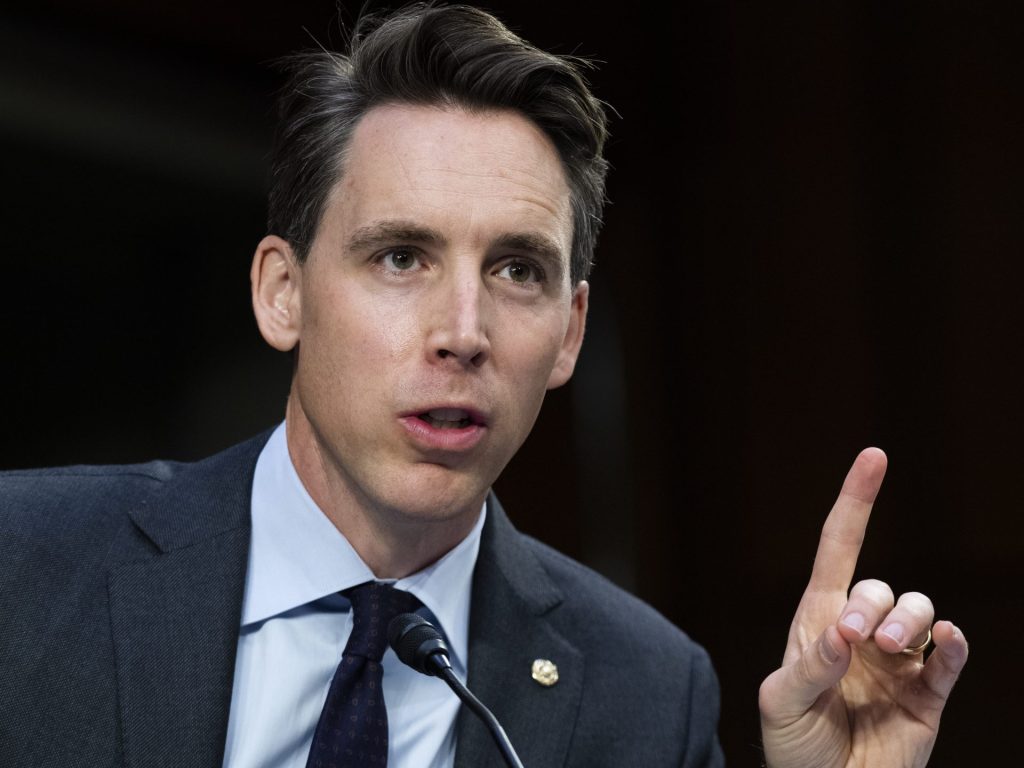
Senator Josh Hawley of Missouri has taken a firm stand against Tracy Stone-Manning, President Joe Biden’s nominee for the Bureau of Land Management (BLM). During a recent Senate oversight hearing, Hawley accused Stone-Manning of lying about her involvement in a 1989 eco-terrorism incident. This confrontation underscores the senator’s commitment to holding government officials accountable and ensuring that individuals with controversial pasts are thoroughly vetted before assuming critical positions.
In 1989, Stone-Manning was implicated in a tree spiking incident in the Clearwater National Forest. Tree spiking, an act of eco-terrorism, involves driving metal spikes into trees, making them dangerous to log and potentially lethal for loggers. At the time, Stone-Manning was an editor for the Earth First journal, which published a story celebrating the Forest Service’s decision to halt their investigation into the spiking incident. This story, devoid of a byline, boasted about federal investigators “bungling” the case, suggesting Stone-Manning’s direct involvement.
Years later, during the confirmation process, Stone-Manning claimed she was never the target of an investigation. However, it was revealed that she received legal immunity in 1993 to testify against her co-conspirators, acknowledging her role only after securing immunity.
Hawley’s interrogation was intense and unyielding. He accused Stone-Manning of misleading the Senate Energy Committee by denying her involvement in the investigation. “You lied to us blatantly,” Hawley asserted, emphasizing the gravity of the incident, which he classified as terrorism capable of causing fatalities. He highlighted the discrepancies in her testimony, underscoring the need for transparency and accountability from public officials.

Stone-Manning defended herself by referencing her extensive career post-incident, attempting to shift focus to her achievements over the past three decades. She expressed frustration over what she perceived as an undue focus on a “salacious moment” from her graduate school days. Nonetheless, Hawley remained steadfast, arguing that her past actions and the misleading nature of her testimony could not be ignored.
The hearing also touched on other contentious issues. Stone-Manning faced criticism for BLM’s handling of energy and mining projects in Alaska, including the reversal of the Ambler Access Project, a key copper mining initiative. Senator Lisa Murkowski of Alaska voiced concerns from Native American groups about the abrupt policy changes, describing them as an “onslaught” against the state’s economic interests.
Stone-Manning cited workload and timing issues as reasons for the delays, but her explanations did little to assuage the concerns of those impacted by BLM’s decisions. The agency’s inability to provide timely advice to Alaskan authorities on various restrictions exacerbated tensions, highlighting the broader challenges faced by BLM under her leadership.
Listen to “Will you FIGHT?” on Spreaker.
From a conservative viewpoint, this incident exemplifies the importance of rigorous scrutiny for government appointees. Ensuring that individuals with potential conflicts or controversial pasts are thoroughly vetted is crucial for maintaining public trust in governmental institutions. Hawley’s confrontation with Stone-Manning reflects a broader commitment within the conservative movement to uphold the principles of integrity and accountability.
The accusations against Stone-Manning raise serious questions about her suitability for leading the BLM. The bureau’s role in managing public lands and resources requires a leader with a clear and unblemished record. The alleged eco-terrorism involvement and subsequent misleading testimony cast a shadow over Stone-Manning’s credibility and capability to lead such a critical agency.